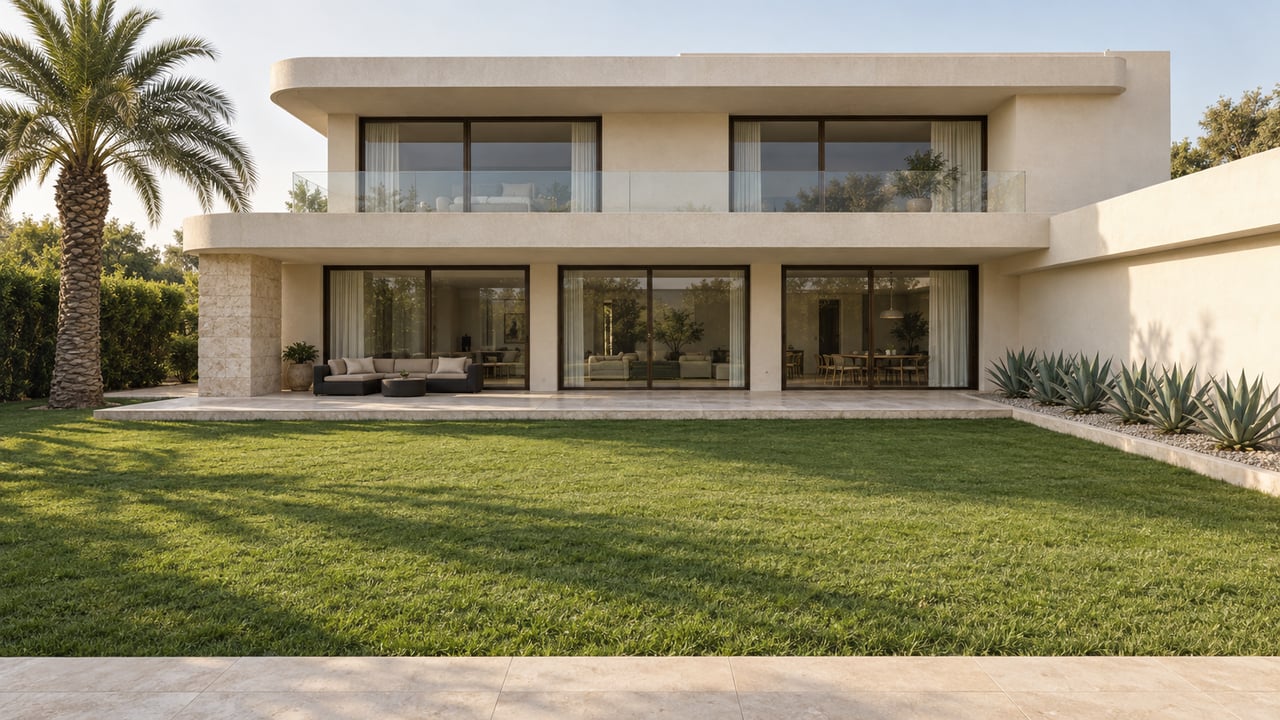
On the first trading day of September 2026, a completed six-bedroom villa in the Ayumi project on Palm Jumeirah sold for AED260 million. Dubai Land Department data put it at about 26,550 square feet, or roughly AED9,792 per square foot. The same day, a second completed villa in the same project was registered with a mortgage of AED130 million.
Eight days later, ValuStrat's August 2026 price index came out. It ranked Palm Jumeirah among Dubai's weakest villa communities, with values down 6.2% from a year earlier. Palm apartments were down 8.6%, the fourth-steepest annual fall of any apartment community in the city.
Both figures are accurate. They describe two different markets that share one island. For a buyer comparing the Palm with Emirates Hills or Jumeirah Bay this autumn, the useful question is which of the two markets a given home belongs to.
The typical Palm home is repricing
ValuStrat's data is based on a fixed basket of properties that the firm describes as representing the market. That basket reflects the ordinary frond villa or tower apartment more than the rare sale that makes headlines. Measured that way, Palm Jumeirah absorbed more of Dubai's 2026 correction than most prime communities.
The citywide picture explains why. Regional disruption in late February brought a 6% fall in values in March. After the April 8 ceasefire, the monthly declines slowed to about 1% in May and June. By August, citywide capital values were 10.2% below their February level.
Prime villa enclaves did not all move together through that period. In August 2026, Jumeirah Islands villas were up 12.2% year on year and Emirates Hills up 7.4%, while Palm Jumeirah sat in the bottom four alongside Mudon, Dubai Hills Estate and Victory Heights. In the apartment rankings, the Palm was grouped with Burj Khalifa, Jumeirah Beach Residence and Town Square at the declining end.
So by the measure that tracks most of the island's housing stock, the Palm has behaved more like Dubai's large waterfront apartment districts than like its gated villa enclaves.
The trophy tier runs on different numbers
The other market is small, and nearly every recent Palm headline comes from it. Through the first eight months of 2026, fäm Properties' analysis of Land Department data counted 35 Palm apartment sales at $10 million or more, together worth AED2.18 billion at an average of AED62.2 million. The same period produced 28 Palm villa sales above that threshold, worth AED1.85 billion at an average of AED66.2 million.
The individual deals show how far this tier sits from the index:
- Ayumi, September 2026: AED260 million for a completed six-bedroom villa, about AED9,792 per square foot.
- Passo by Beyond, July 2026: AED90 million for a 12,400-square-foot waterfront villa, about AED7,265 per square foot.
- Armani Beach Residences, March 2026: AED92.5 million for a five-bedroom, 11,521-square-foot residence in Arada's Tadao Ando-designed scheme.
For scale, ValuStrat put the citywide weighted average villa value in August 2026 at AED2,035 per square foot. The Ayumi sale cleared at nearly five times that rate, in the same quarter that the Palm's representative villa lost value year on year. A basket built to represent the market is not designed to track a home like that. Most buyers will never transact in that tier either.
Why the top held: owners who can wait
Why did prices at the very top hold while typical homes fell? Two things suggest the answer is seller behavior more than buyer demand.
The first is refinancing. Savills reported that by the end of Q2 2026, refinancing accounted for around 70% of valuation instructions across Dubai, compared with a historical level closer to 30%. Its reading was that existing owners were choosing to restructure their financing rather than sell. That figure covers the whole city. The AED130 million mortgage registered on the second Ayumi villa shows that large-scale financing against completed Palm trophy homes is continuing.
The second is how sellers acted during the shock itself. In late March 2026, Gulf News reported Smart Bricks data showing that about 85% of Dubai landlords were not considering a sale. Listings had risen only a little over 5%, and roughly 65% of the added listings were homes coming back to market after failing to sell earlier. Those are citywide figures from the worst weeks of the disruption, but they describe the same pattern. Very little new supply came to market.
When the owners of the rarest homes face no pressure to sell, the few homes that do trade are priced by sellers who can afford to wait. At the level of the typical home, where more owners have a reason to sell and buyers have more alternatives, prices move toward where buyers are. That is the gap between the two Palm markets.
The record counts are running late
The $10 million-plus figures also arrive late. Knight Frank counted a record 296 Dubai home sales above $10 million in H1 2026: 165 in Q1 and 131 in Q2, including a record 26 above $25 million in Q2. Palm Jumeirah had 50 of those sales, one behind Dubai Hills Estate's 51.
Faisal Durrani, Knight Frank's Head of Research for MENA, attached a caveat. He said the half-year numbers largely reflect deals agreed before the regional conflict, because a sale typically takes four to six weeks to be registered. Nicholas Spencer, the firm's Head of Residential for MENA, said prime communities had been considerably more resilient than the mainstream market, where prices eased by 5% to 20% depending on location. He also noted early signs that prime price growth was softening.
How strong the "prime market" looks also depends on where each firm draws the line:
- Savills, AED10 million and above: transactions fell 54% quarter on quarter in Q2 2026, to 864.
- Betterhomes, AED15 million and above: July 2026 transactions rose 22% from June but were 46% below July 2025. Palm Jumeirah led the luxury transfers that month.
- ValuStrat, AED30 million and above: August 2026 recorded 14 ready-home sales, 12 of them above AED50 million, concentrated in Palm Jumeirah, Emirates Hills, District One, Jumeirah Bay Island, Al Barari and Dubai Marina.
- Knight Frank, $10 million and above: a record first half, built largely on deals agreed before the disruption.
These measure different sets of transactions and cannot be added together or compared like for like. Read side by side, they show the same pattern from different angles. The higher the threshold, the healthier the market looks. The band where most "prime" Palm buyers actually shop, between AED10 million and the true trophy level, is where activity thinned most in Q2.
Where that leaves a buyer comparing the Palm
For someone looking at a standard frond villa or a Shoreline-era tower apartment, the August index is the more relevant number. Representative values are below where they were a year ago, and the trophy sales do not change that. The Savills analysis expects performance to become increasingly localized, with supply-constrained, best-in-class locations holding up better. On the Palm, that line seems to run between individual buildings and plots rather than around the island as a whole.
For someone pursuing a signature villa, a completed Ayumi-grade home or a branded residence, the index does not help. Financing against trophy homes is still being registered, and owners across Dubai have leaned toward refinancing over selling. The comparable evidence comes from a few registered deals, each at a different price per square foot, and from what can be learned privately about which owners are prepared to sell.
On paper, this places the Palm in a different position from Emirates Hills. In August, Emirates Hills villas were rising even at the representative level. On the Palm, the strength sits only at the top of the market.
Common questions
Is the 6.2% fall a drop in what Palm homes sell for? It is the year-on-year change in ValuStrat's capital values for Palm villas as of August 2026. ValuStrat bases its data on a fixed basket of properties it describes as representing the market, so a single trophy sale does not move the figure the way it moves the headlines.
Have prices stopped falling? Citywide, ValuStrat's index slipped 0.2% month on month in August 2026, a much slower pace than the 6% fall in March. As of early October 2026, August is the latest community-level reading available for the Palm.
Does the Ayumi sale set a benchmark for other Palm villas? It sets one for completed homes of comparable size and specification. Even within the trophy tier, the Passo sale two months earlier cleared at about AED2,500 less per square foot.
Whether a particular Palm home trades in the repricing market or the owner-held trophy market shapes everything from the opening offer to whether it ever reaches open listing. If you are weighing a frond villa against a branded residence, or the Palm against Emirates Hills, Leigh Williamson can show you which recent sales actually apply to the home you are considering. Let's Connect.