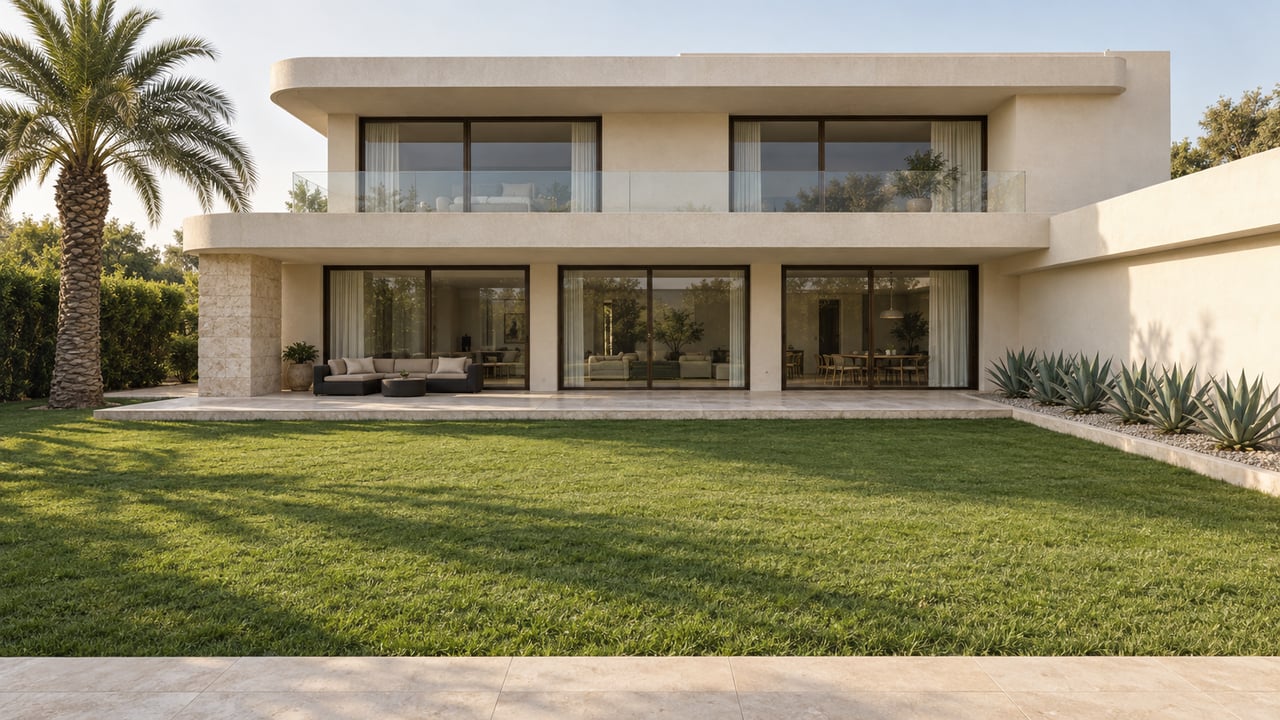
In January 2026, a renovated six-bedroom mansion on 29,000 square feet inside Emirates Hills changed hands for AED 233.5 million. The price worked out to AED 8,000 per square foot, a figure that ran 40.3% above the community's own average and set a new benchmark for the neighborhood. Leigh Borg, an Executive Director at Dubai Sotheby's International Realty, closed the deal. It was his tenth high-value transaction of the year, and it landed among the three highest sales Emirates Hills had recorded in the preceding twelve months.
Read on its own, the sale looks like proof of an overheating market. Read against the full-year numbers behind it, it tells a different story.
Emirates Hills recorded AED 2.9 billion in total sales across 2025, a 20.8% increase in transaction value from the year before. In the same period, the number of properties that actually changed hands fell by 17.6%. Total sales value went up. Transactions went down. That combination means the average value per transaction rose, not necessarily that the homes sold were bigger.
This is the piece of the Emirates Hills story that a portal median doesn't show you, and it changes how you should read every other number in the neighborhood.
Higher Value, Fewer Transactions
A rising median price can signal more buyers competing for the same supply, but the 2025 figures here track total sales value and transaction count, not the median. They therefore don't establish whether buyer competition increased. Emirates Hills' 600 or so villas were never going to multiply, since the community was built out decades ago and no new "white plots," the original custom-build parcels Emaar sold to first owners, remain on the open market. The figures show fewer transactions alongside more total value, but don't establish whether that reflects a narrower buyer pool, larger homes, or another mix of factors.
For anyone comparing Emirates Hills against Dubai Hills Estate or Palm Jumeirah on price alone, this matters. A lower transaction count alongside a rising total value signals a different pattern from growth in transaction volume, and it can affect how a negotiation is approached. There are fewer comparable sales to anchor a valuation, and the ones that exist skew toward the top of the range, because that's increasingly where the activity is.
Private Sales and Public Listings
The AED 233.5 million sale closed through a named brokerage with a named agent, and it made the press. Most Emirates Hills transactions don't work that way.
In August 2025, a 50,000 square foot plot on the community's most sought-after stretch, known locally as the Golden Mile, sold for AED 260 million. It was never publicly listed. Buyers had to pass a pre-qualification process before they were even permitted to view it. Fabricio Saltini of Eden Realty represented the seller, and Michael Charalambous of Dubai Sotheby's International Realty represented the buyer, according to Khaleej Times' coverage of the deal. The privacy wasn't incidental. At this end of Emirates Hills, it's the point.
Even the community's most talked-about single sale, a Versailles-inspired mansion built over roughly twelve years and known informally as the Marble Palace, doesn't have a price everyone agrees on. Depending on the outlet, the reported figure runs anywhere from AED 367 million to AED 425 million, a gap wide enough to constitute a headline sale in most other Dubai neighborhoods on its own. The variation in published figures makes even a prominent sale difficult to compare; quieter deals without press coverage may have less public detail.
Local brokerages that work the community regularly estimate that a majority of Emirates Hills sales close before they ever reach a public listing. That tracks with what the visible deals show: pre-qualification requirements, off-market plots, and a buyer profile that tends to already know what it wants before a listing exists to find. What it means practically is that the comparable sales visible to a typical buyer researching Emirates Hills online represent a filtered subset of the real market, skewed toward whatever happened to become public.
The Cost Structure Runs Backward From What You'd Expect
Given the price of entry, most buyers assume the ongoing cost of owning in Emirates Hills scales with it. It doesn't.
| Community | Typical price range | Service charge per sq ft |
|---|---|---|
| Emirates Hills (villas) | roughly AED 35 million and up | approximately AED 1.5 to 1.7 |
| Dubai Hills Estate (villas) | roughly AED 3.4 million to over AED 22 million | approximately AED 3 to 4 |
| Downtown Dubai (apartments, for scale) | citywide's highest service-charge district | approximately AED 21 |
Downtown has no villa product to compare against Emirates Hills directly, but it's useful precisely because it marks the upper bound of what Dubai residential ownership can cost annually. Emirates Hills sits near the bottom of that same range despite carrying some of the highest per-square-foot sale prices in the emirate.
The reason is structural rather than a pricing quirk. Villa owners in Emirates Hills maintain their own homes privately. What the community charge actually funds is roads, lakes, gates, and shared landscaping around the golf course, not lobbies, elevator banks, or central cooling systems shared across hundreds of units in a tower. A Downtown apartment owner is paying into a building. An Emirates Hills villa owner is paying into a perimeter.
This same logic explains why published rental yields for Emirates Hills look unremarkable next to the rest of Dubai's villa market, typically cited somewhere between 2% and just over 4% gross, against a citywide villa average closer to 5% in early 2025. A low yield next to a low carrying cost isn't a warning sign here. It's consistent with what the community is actually being bought for: capital preservation on an asset that will never see meaningfully more supply, not a rental return play.
Where This Sits Heading Into Late 2026
The 2025 pattern, fewer deals producing more value, hasn't reversed this year. Dubai's ultra-luxury villa segment saw individual transactions surpass the AED 400 million mark in 2025, and Dubai Sotheby's International Realty put the average super-prime sale price at AED 68.32 million for the year, with high-value activity concentrated specifically in Emirates Hills, Palm Jumeirah, and Jumeirah Bay Island. The firm's own outlook, cited by Arabian Business, pointed to continued UK wealth migration as the reason to expect that pattern to hold through 2026, following legislative and tax changes that have pushed a wave of high-net-worth British buyers toward Dubai.
Citywide, the broader market did cool through the second quarter of 2026. Total residential transactions fell 19% quarter over quarter to 35,884 deals as a record wave of roughly 27,300 handovers hit the market, and average villa and townhouse prices eased slightly to around AED 1,646 per square foot, according to Savills' Q2 2026 market report. Even with that quarterly softening, villa and townhouse prices stayed roughly 8.5% above year-ago levels. Savills also noted that activity stayed concentrated in the city's most established luxury addresses, naming Palm Jumeirah, Dubai Hills Estate, and Jumeirah Golf Estates specifically. That's the same behavior Emirates Hills already showed in 2025, just now visible across the wider top tier of the market.
What This Means If You're Comparing Communities
None of this means Emirates Hills is a bad comparison point for Dubai Hills or Palm Jumeirah. It means the comparison has to account for a market that behaves less like a typical residential segment and more like a small, closely held asset class. Fewer transactions mean thinner public data. A large share of what actually trades never reaches a portal. And the ongoing cost of ownership runs in the opposite direction from what the entry price would suggest.
A buyer weighing Emirates Hills against a newer golf-course community isn't just comparing two price tags. They're comparing a market with a visible, liquid comparable set against one where the real comparables are frequently private, and where rising total sales value alongside fewer transactions points to a higher average value per transaction without showing whether the buyer pool is larger or smaller.
Common questions
If fewer properties are selling, is Emirates Hills losing value? The figures don't establish that Emirates Hills is losing value: total sales value rose 20.8% in 2025 even as transaction count fell 17.6%. That points to a higher average value per transaction, but doesn't by itself show whether individual property values rose or what drove the change.
If most sales happen privately, how would I actually see what's available? Working with an advisor who has existing relationships inside the community is the practical answer. A meaningful share of Emirates Hills inventory never reaches a public listing, and pre-qualification is often required before a viewing is even arranged.
Comparing Emirates Hills against Dubai Hills, Palm Jumeirah, or another prime address deserves the same level of scrutiny we'd apply to any transaction of this scale. If you're weighing that decision, Leigh Williamson can walk you through what the public numbers don't show. Let's Connect.
This article is general information, not legal, tax or financial advice. Consult a qualified professional about your situation.