Are you weighing a villa in Emirates Hills and want true, long-term control of the land beneath it? You are not alone. Many global families prefer freehold ownership for clarity, transferability and bankability, yet Dubai’s legal terms can feel unfamiliar. This guide explains how freehold works in Dubai, what a DLD title deed gives you, how it differs from leasehold and usufruct, and the practical steps to protect value in Emirates Hills. Let’s dive in.
Freehold in Dubai, in plain terms
Freehold in Dubai means you own the defined property interest for an unlimited time, subject to local laws, planning controls and any registered encumbrances. Your ownership is formalized by registration of a title deed at the Dubai Land Department, often called the DLD title deed.
Dubai allows foreign ownership of freehold property in designated areas. Emirates Hills is one of these areas, built as a master-planned, developer-managed freehold villa community where expatriates and foreign corporates commonly buy and sell.
What your DLD title deed gives you
Core rights
- Exclusive possession and the right to use and occupy the property.
- The right to sell, gift or otherwise transfer the property, subject to DLD transfer procedures and any community covenants.
- The ability to mortgage the property with UAE-licensed lenders, subject to lender policies and existing encumbrances.
- The right to lease the property and collect rental income.
- The ability to bequeath the property, with succession handled under UAE rules unless you arrange an alternative through a registered will.
Practical limitations
- Community or owners’ association rules can restrict exterior works and require approvals for alterations.
- You remain responsible for service charges, utilities, insurance, maintenance and relevant municipal or regulatory fees.
- Ownership remains subject to any registered mortgages, liens or planning controls that affect the property.
How transactions work
Resale vs new-build
- Resale: You and the seller sign a sale and purchase agreement, complete title and encumbrance checks at the DLD, lodge transfer forms, pay transfer fees and register the new title.
- Off-plan or new build: RERA escrow and developer protections apply. On completion, the property is transferred and the title is registered with the DLD.
Costs to budget
- DLD transfer fee, commonly expressed as a percentage of the sale price. Confirm the current rate before you commit.
- Real estate agent commission, typically a percentage and negotiable in resale transactions.
- Mortgage registration fees and bank charges if you choose to finance.
- VAT at 5 percent may apply to some real estate-related services such as agency or property management. Confirm treatment for your case.
- Ongoing costs: service charges, utilities, insurance, maintenance and any municipal fees.
Financing considerations
- UAE banks commonly accept DLD-registered freehold title deeds as mortgage security. Loan-to-value, rates and eligibility vary for residents, non-residents and corporate borrowers.
- Lenders complete KYC and AML checks. If you purchase through an offshore or corporate structure, terms and bank acceptance can differ, so align structure with bankability early.
Taxes, VAT and corporate structures
There is no personal income tax or personal capital gains tax on property disposals for individuals under typical private ownership scenarios. The UAE’s federal corporate tax applies to business profits for financial years starting on or after 1 June 2023, which matters if a company holds the property as part of trading or investment activities. Family offices and holding companies should model corporate tax effects and any exemptions with tax advisers.
VAT at 5 percent exists in the UAE and can apply to certain services connected to real estate. Treatment is specific to the service and deal structure. Confirm details with a qualified adviser for each transaction.
Freehold vs leasehold vs usufruct
- Freehold: Perpetual ownership of land and improvements, subject to law and registration. Strongest control, easiest to mortgage and transfer, well suited to long-term family ownership and estate planning.
- Leasehold: Exclusive possession for a defined term under a lease. Rights end when the lease expires unless renewed, and saleability and bankability can diminish as the term shortens.
- Usufruct: A right to use and enjoy property, including income, for a set period while the underlying title remains with another party. Effective economic control during the term, but rights revert at expiry.
Focus on your intended hold period, your need to renovate or finance, estate planning goals, and the liquidity of the interest you are buying.
Emirates Hills specifics that matter
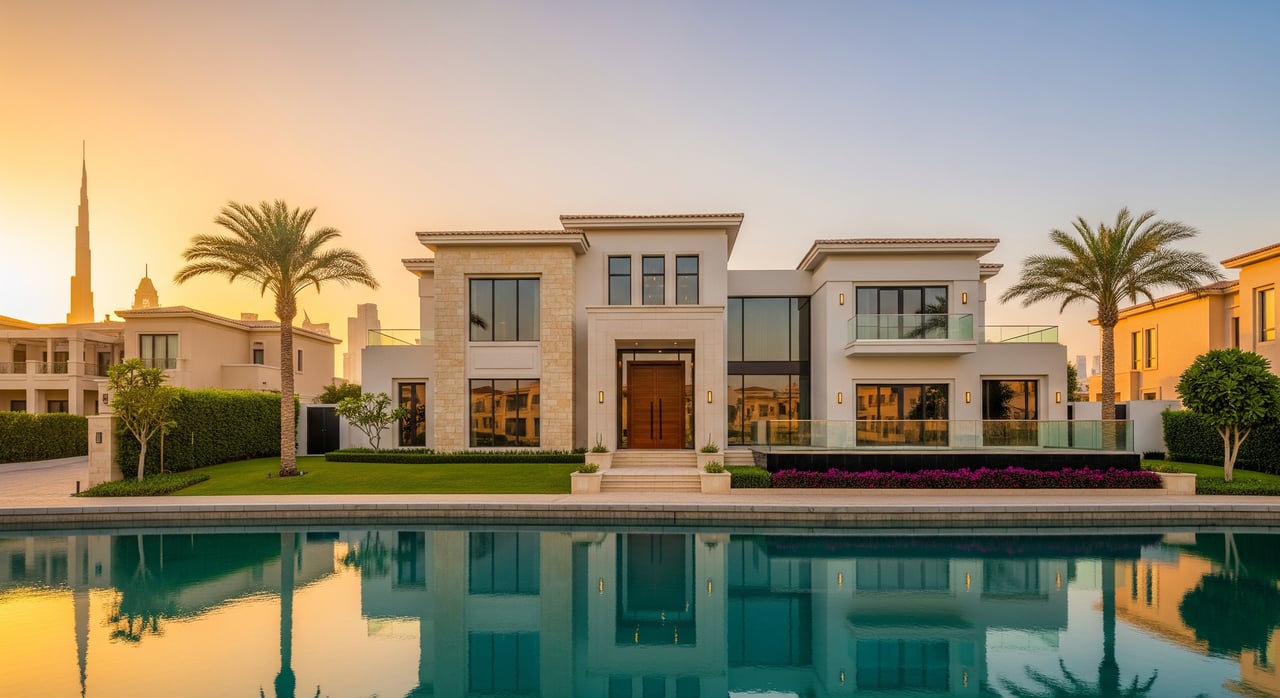
Emirates Hills is a gated, master-planned villa estate developed by Emaar, positioned at the ultra-prime end of Dubai’s residential market. The community is typically managed by a developer-appointed company and an owners’ association. Service charges fund landscaping, security, infrastructure and shared amenities.
Ultra-prime villas trade less frequently than mid-market homes, so you should expect smaller pools of qualified buyers and potentially longer disposal timelines. Rental yields are often lower in ultra-prime estates. Many buyers prioritize capital preservation, privacy and amenity rather than maximizing yield. Service charges and maintenance for large plots can be significant, so plan cash flows over multi-year horizons. Privacy, security and prestige are core value drivers, and some buyers prefer low-visibility holding structures within regulatory rules.
Due diligence checklist for buyers
- Confirm the DLD title deed type and registration status for the specific plot or villa.
- Order an official DLD title search to review encumbrances, mortgages, liens and caveats.
- Review the sale and purchase agreement and any side letters for representations, warranties and obligations.
- Check for any service-charge arrears and confirm owners’ association rules, including architectural controls and approvals for alterations or expansions.
- Verify utilities, connection charges and any planned community or infrastructure works that could affect your parcel.
- Obtain current and historical service-charge schedules and ask about planned increases or capital assessments.
- Confirm planning setbacks, plot restrictions, rights-of-way or easements.
- Model transaction costs, ongoing holding costs and potential exit scenarios, including corporate tax exposure if purchasing via a company.
- Align your holding structure with lending appetite if you plan to finance.
Risk planning for long holds
- Liquidity in the ultra-prime segment: Plan for a multi-year hold and maintain flexibility on pricing and timing. Use family office networks for off-market reach.
- Regulatory or tax changes: Keep current on UAE corporate tax and VAT developments. Maintain an adaptable holding structure and schedule periodic tax reviews.
- Rising service charges or capital calls: Review historic service-charge records and budget reserves. Where possible, negotiate protections in your sale documents.
- Succession complexity: Align title with a registered will and coordinate with local counsel to avoid disputes and ensure smooth transfer.
- Financing constraints on certain entities: Consult banks early to confirm mortgageability of your chosen structure.
Succession and wealth transfer
By default, UAE succession rules apply, including Sharia for Muslims. Many non-Muslim owners register wills under available mechanisms in Dubai to express succession wishes that cover UAE property. If you plan to hold through a trust or corporate vehicle, coordinate with local and cross-border counsel so the ownership structure and the will align with title registration and bank requirements.
Next steps
Freehold ownership in Emirates Hills can deliver long-term control, marketable title and bankable security when paired with careful due diligence and the right structure. If you value privacy, capital preservation and a disciplined acquisition process, a focused advisory approach will help you source the right villa, benchmark costs and mitigate risk across the hold period.
If you would like a discreet, end-to-end advisory on Emirates Hills acquisitions or exits, connect with Leigh Williamson for a conversation.
FAQs
What is freehold ownership in Emirates Hills?
- It is perpetual ownership of the villa and land, recorded on a Dubai Land Department title deed, subject to local laws, community rules and any registered encumbrances.
What does a DLD title deed actually confer?
- It confirms legal ownership and supports your rights to occupy, sell, gift, lease and mortgage the property, provided you follow DLD procedures and community covenants.
What costs should I expect when buying in Emirates Hills?
- Budget for DLD transfer fees, agent commission, mortgage registration and bank charges if financing, possible VAT on related services, and ongoing service charges, utilities, insurance and maintenance.
How do banks view Emirates Hills freehold villas?
- UAE lenders commonly accept DLD-registered freehold villas as collateral, with loan terms varying by borrower profile and holding structure; confirm bank appetite early if using a company or offshore vehicle.
How are inheritance and wills handled for non-Muslim owners?
- By default UAE succession rules apply, but many non-Muslim owners register a local will to direct how UAE property passes, coordinating with legal counsel to align title and estate plans.